Program Manager Resume Sample: Expert Guide for 2025

In 2025, program manager jobs remain some of the most competitive and rewarding roles in the IT and business sectors. But here’s the truth: even the most talented candidates risk being overlooked if their resume doesn’t reflect their skills, leadership, and achievements clearly. Crafting a strong program manager resume is not just about listing your job titles—it’s about presenting your expertise in a way that aligns with employer expectations.
In this article, we’ll explore what makes a program manager stand out, what employers look for, and how to structure a resume that gets noticed. You’ll also find a program manager resume sample to guide you through the process.
Who is a Program Manager?
So, what is a program manager? Unlike project managers who oversee individual projects, program managers focus on the bigger picture. They manage multiple related projects, ensuring that they align with organizational goals and deliver measurable value.
A program manager is:
- A leader who aligns projects with business strategy.
- A communicator who bridges the gap between stakeholders and teams.
- A strategist who sees beyond tasks and focuses on outcomes.
Simply put, program managers are responsible for orchestrating complexity and ensuring long-term success.
What Does a Program Manager Do?
If you’re asking, what does a program manager do?, the answer is broad. Their duties vary depending on the company and industry, but the core responsibilities typically include:
- Overseeing multiple related projects simultaneously.
- Coordinating cross-functional teams.
- Managing budgets and allocating resources.
- Tracking progress and measuring outcomes.
- Communicating with stakeholders and executives.
- Identifying risks and developing mitigation strategies.
In essence, program managers combine strategic thinking, leadership, and execution skills to deliver results.
Program Manager Roles and Responsibilities
Let’s break down the program manager roles and responsibilities that commonly appear in job descriptions:
- Strategic Planning – Aligning program goals with organizational objectives.
- Budgeting & Resource Allocation – Ensuring efficient use of time, people, and money.
- Stakeholder Communication – Reporting to leadership and maintaining transparency.
- Team Leadership – Coaching, motivating, and guiding project managers and staff.
- Risk Management – Identifying potential issues before they escalate.
- Performance Tracking – Measuring progress and ensuring project deliverables meet expectations.
A program manager professional resume should highlight these areas with clear examples of past achievements.
Sample Program Manager Resume
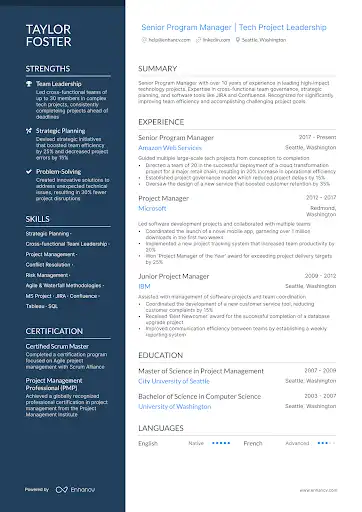
A resume sample helps you see how all the pieces fit together. Below is a placeholder for where the program manager resume sample can be inserted:
This sample demonstrates how to organize your resume into essential sections: personal summary, career history, duties, skills, and strengths.
Sections of a Program Manager Resume
Personal Summary
This is your professional introduction. Keep it concise—2–3 sentences that highlight your experience and leadership qualities. Avoid unnecessary details; save stories for your cover letter.
Career History (Work Experience)
List your previous positions in reverse chronological order. Focus on relevant jobs connected to program manager roles and responsibilities. Use bullet points to describe accomplishments, not just duties. For example:
- Directed a portfolio of 7 IT projects with a combined $10M budget.
- Increased project delivery efficiency by 22% through process optimization.
Duties and Responsibilities
Answer the critical question: What does a program manager do? Include only 5–8 high-impact responsibilities. Be specific rather than generic. For instance:
- Developed and executed long-term IT transformation strategies.
- Led stakeholder communication, improving satisfaction scores by 15%.
Skills
Include both hard and soft skills. Examples:
- Hard skills: Agile methodology, budget forecasting, program scheduling.
- Soft skills: Strategic thinking, communication, negotiation, leadership.=
Strengths
Optional but impactful. Highlight unique traits, such as crisis management or building global teams. Remember: if you share strengths, be prepared to discuss weaknesses during interviews.
How to Become a Program Manager
Wondering how to become a program manager? It’s not an overnight process. Most successful professionals follow this path:
- Education – A Bachelor’s degree in management, IT, or a related field is typically required. Many also pursue an MBA.
- Experience – Start as a project manager or team lead to gain practical skills.
- Certifications – Credentials like PMP (Project Management Professional), PgMP (Program Management Professional), or Agile certifications increase credibility.
- Skill Development – Constantly refine leadership, communication, and technical abilities.
- Networking – Build professional relationships to open doors to new opportunities.
By combining qualifications with hands-on experience, you can successfully transition into program management.
Writing an Excellent Program Manager Resume
Crafting a standout resume requires strategy. Here are key steps:
- Tailor It to the Job – Customize your resume for each role. Use resume alignment with job requirements and adjust based on the description.
- Highlight Achievements – Use measurable results (e.g., “Saved $1M annually by streamlining processes”).
- Use Strong Keywords – Employers scan for terms like “strategic planning,” “cross-functional leadership,” or “risk management.”
- Keep It Clear – A cluttered resume is hard to read. Stick to 1–2 pages.
- Add a Professional Resume Touch – If you want a flawless document, consider working with experts. Services like ProResumeHelp specialize in writing tailored, professional resumes for IT and management roles.
Why Your Resume Matters More Than Ever in 2025
With thousands of applications flooding into companies daily, applicant tracking systems (ATS) filter resumes before they reach recruiters. This means resume refinement for positions is not optional—it’s essential.
In 2025, employers expect:
- Concise, impactful summaries.
- Evidence of leadership in action.
- Clear alignment with company goals.
A generic resume will rarely pass ATS checks. Instead, aim for a resume personalization guide approach that demonstrates your ability to adapt to the specific role.
Final Thoughts
The journey to landing program manager jobs starts with one critical step: creating a compelling, well-structured resume. Whether you’re an experienced professional or just stepping into leadership, your resume should clearly answer:
- What is a program manager?
- What does a program manager do?
- Why are you the right candidate for this role?
A strong program manager resume is more than a formality—it’s your ticket to new career opportunities. And if you’re unsure where to begin, remember that professional services like ProResumeHelp specialize in crafting resumes that highlight your strengths and help you stand out in a competitive job market.