How to Write an IT Resume That Gets Noticed in 2025

Introduction
The IT field is one of the most promising industries in 2025. Whether you’re an entry-level graduate or a seasoned professional, you’ve chosen a career path with enormous potential. But competition is fierce. Every position attracts hundreds of candidates, many of them equally skilled. To get noticed, you need a resume for IT job that not only highlights your strengths but also adapts perfectly to employer requirements.
In this article, we’ll explore how to create a professional IT resume that gets past Applicant Tracking Systems (ATS) and impresses hiring managers. You’ll also find a free IT resume sample that you can customize for your own job search.
Free IT Resume Sample
Here is where you can insert a resume sample that demonstrates the ideal structure and content for IT professionals:
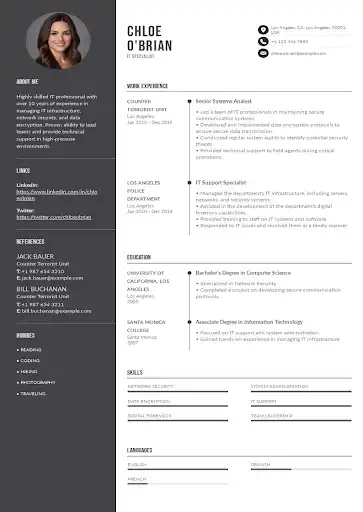
Use this as your starting point and refine it to fit your personal career journey.
Why Tailoring Matters
A generic resume no longer works. Recruiters spend less than ten seconds scanning applications, and most companies use ATS filters to eliminate unsuitable candidates before a human ever sees the file. Studies show that nearly three-quarters of resumes fail this initial screening.
That’s why you must customize your resume for each job. Resume tailoring is about carefully adjusting your profile so it reflects the specific skills, achievements, and certifications a company is looking for. By following resume customization tips, you demonstrate that you’re not just qualified but also attentive to detail and aligned with the employer’s expectations.
The Structure of an IT Specialist Resume
A strong resume is built on clear structure. Let’s walk through each section of a modern IT resume format and how to refine it for the best results.
Contact Information
Place your full name, phone number, and a professional email at the top. Include your city and state but skip the full address. For IT professionals, it’s crucial to add links to LinkedIn, GitHub, or a personal portfolio site. Employers expect to see real projects and code samples.
Professional Summary
Your summary should be short—two to three sentences—but powerful. Instead of vague claims, explain what you’ve accomplished and why you’re the right person for the role. For example:
“IT Specialist with five years of experience in cloud administration and network security. Reduced system downtime by 30% through automation and improved data protection with advanced firewall solutions. Adept at resume alignment with job requirements through scalable IT project delivery.”
Work Experience
This section should be more than a list of job duties. Focus on measurable results that prove your impact. For instance, instead of writing “Managed servers,” you might say: “Optimized server performance to reduce downtime by 25%, saving the company $50,000 annually.” Numbers and outcomes make your experience far more convincing.
IT Resume Skills
Skills are vital in an IT resume. Divide them into technical and soft skills.
Technical skills include programming languages, operating systems, cloud platforms, cybersecurity tools, and database management. Soft skills are often underestimated but equally valuable: teamwork, communication, decision-making, and problem-solving. Employers want IT specialists who can code, but also collaborate, lead, and adapt under pressure.
Education and Certifications
List your degrees and, if possible, emphasize relevant IT certifications. Credentials like CompTIA Security+, Cisco CCNA, AWS Solutions Architect, or Microsoft Azure Administrator often tip the balance in your favor. They not only validate your knowledge but also show commitment to continuous learning.
Additional Sections
You may also include projects, awards, or programming languages as separate sections. For entry-level applicants, a portfolio of personal or academic projects can be just as valuable as professional experience.
Resume for IT Job: Trends of 2025
The hiring landscape evolves quickly, and resumes need to keep up. In 2025, several trends shape what employers expect.
First, resumes must be ATS-friendly. That means sticking to simple formats without images or elaborate designs. Second, AI is changing how resumes are screened. Employers increasingly use automated tools to match applications with job descriptions. To succeed, you need to mirror the language of the posting and highlight the exact competencies mentioned.
Another trend is the rise of skills-based resumes. If you’re changing careers or lack formal work experience, placing your skills and certifications before your job history can help recruiters quickly see your potential. Finally, hybrid and remote work have become standard. Mentioning tools like Slack, Jira, or GitHub shows you’re ready for modern collaboration.
How to Tailor Your Resume Step by Step
Customizing your resume can feel overwhelming, but a systematic approach makes it easier.
- Analyze the job description. Highlight keywords and technical requirements.
- Rewrite your summary. Adjust it so it mirrors the company’s needs.
- Quantify your achievements. Replace duties with measurable results.
- Reorganize sections if needed. Put the most relevant skills and projects up front.
-
Proofread carefully. Even a single typo can ruin your credibility.
This process may take extra time, but it’s the essence of effective resume tailoring.
IT Resume Skills in Detail
Employers expect a combination of hard and soft skills. On the technical side, strong candidates typically demonstrate programming knowledge in languages like Python, Java, or C++, proficiency in cloud services such as AWS or Azure, and experience with database systems.
Yet technical expertise alone is not enough. Many candidates are filtered out because they fail to highlight interpersonal strengths. Leadership, creativity, and the ability to work under pressure are just as important. Remember, IT departments thrive on collaboration, and hiring managers want professionals who can contribute beyond code.
Examples of Resume Targeting Techniques
Let’s look at how tailoring works in practice.
- For a cybersecurity role, instead of writing “Worked on security systems,” a stronger version would be: “Implemented advanced firewall protocols that reduced intrusion attempts by 92% and ensured compliance with data protection laws.”
- For a software developer role, change “Wrote code for websites” into: “Developed and deployed a full-stack e-commerce platform that increased client sales by 40% within six months.”
- For a cloud specialist role, replace “Managed cloud servers” with: “Optimized AWS infrastructure, cutting monthly costs by 25% while improving uptime to 99.99%.”
These examples show how resume modification for applications can transform ordinary duties into compelling proof of value.
Common Mistakes to Avoid
Many IT applicants undermine themselves with avoidable errors. Some overload their resumes with technical jargon that confuses recruiters. Others submit the same resume to multiple jobs without adjustments. Some rely on empty buzzwords like “innovative” or “hardworking” without evidence. Poor formatting is another red flag, as is ignoring soft skills altogether.
Avoiding these pitfalls is part of resume refinement for positions. Always ask yourself: Does this resume clearly show why I’m the best fit for this job?
Why Consider a Certified Resume Writer
Writing your own resume can be tough. You know your skills, but presenting them in the best possible light isn’t easy. That’s why services like Resume101 exist. A certified resume writer can craft a professional IT resume that captures your strengths, aligns with the latest trends, and highlights your competitive advantage. For many job seekers, this investment saves time and dramatically improves results.
Conclusion

In the fast-moving IT job market of 2025, you can’t afford to send out generic resumes. Success comes from resume personalization, adaptation strategies, and job-specific tailoring. By structuring your resume correctly, quantifying achievements, and aligning with employer expectations, you position yourself as a candidate who can’t be ignored.
Whether you use the IT resume sample provided here or work with a certified professional, the key is refinement. Keep adjusting, improving, and personalizing. That’s how you turn your experience into opportunities and your resume into interviews.