How to Write a Resume: We Know All the Secrets of 2025

Why Resumes Still Matter in 2025
It’s 2025, and despite the rise of AI-driven recruitment tools, personal branding platforms, and networking apps, the resume remains one of the most powerful tools for landing a job. A well-written resume isn’t just a list of your work history—it’s your personal marketing document, designed to show employers why you’re the best fit.
The problem? Too many job seekers still use a “one-size-fits-all” resume. Employers want tailored resumes that demonstrate alignment with their job requirements. That’s where resume customization comes in. In this guide, we’ll reveal the latest resume targeting techniques, adaptation strategies, and resume refinement methods that will help you stand out in 2025.
Why Tailoring Your Resume Matters More Than Ever
Recruiters spend an average of 7–10 seconds scanning a resume. Applicant Tracking Systems (ATS) are more advanced now, using AI to analyze whether your resume matches the job description.
Here’s why resume customization is crucial:
- Beats the ATS: Optimizing your resume for the job description ensures your application doesn’t get filtered out.
- Shows genuine interest: Employers can tell when you’ve invested time in customizing your resume.
- Highlights relevant achievements: Tailoring allows you to emphasize the skills and results that truly matter for the position.
Step 1: Understand the Job Description
Before you begin, study the job description carefully. Employers often give you the roadmap for success if you know how to read it.
Look for:
- Core skills the employer repeats.
- Job responsibilities that align with your past achievements.
- Keywords used in the posting (essential for ATS).
Pro Tip: Copy the job description into a word cloud generator. The most frequent words are the ones you should reflect in your resume.
Step 2: Resume Alignment With Job Requirements
This is where resume targeting techniques come in. Ask yourself:
- Does my resume highlight the same skills listed in the job post?
- Have I provided personalized resume examples that prove I’ve handled similar challenges?
- Am I using resume refinement for positions that require specific technical knowledge?
Think of your resume as a puzzle piece—you want it to fit perfectly into the employer’s picture of their ideal candidate.
Step 3: Resume Customization Tips for Each Section
Contact Information
- Always include your LinkedIn (updated for 2025 with AI-generated headline summaries).
- If relevant, add a portfolio link, GitHub, or personal website.
Resume Summary
Instead of a generic objective, write a tailored summary. For example:
❌ “Seeking a challenging role to grow my career.”
✅ “Marketing strategist with 5+ years of experience driving brand growth through data-driven campaigns. Proven success in increasing ROI by 30%—seeking to apply these skills as a Digital Marketing Manager at [Company Name].”
Work Experience
- Use resume adaptation strategies to reorder achievements based on job relevance.
- Apply the STAR method (Situation, Task, Action, Result) to make your bullet points impactful.
- Integrate keywords naturally—don’t just stuff them.
Example:
“Led a cross-functional team to redesign the company’s e-commerce platform, improving site performance and increasing conversion rates by 22%.”
Skills Section
- Avoid generic skills like “teamwork” or “Microsoft Office.”
- Instead, show job-specific resume writing by adding tools, frameworks, and certifications directly relevant to the role.
Education
- Highlight coursework or projects if you’re a student or recent graduate.
- For career changers, showcase additional certifications or online learning credentials.
Step 4: Resume Adjustment Methods for Different Career Stages
Students and Recent Graduates
- Focus on internships, volunteer work, and class projects.
- Use a resume personalization guide to highlight transferable skills like communication, leadership, or research.
Career Changers
- Emphasize resume modification for applications that showcase relevant transferable skills.
- Use a functional or hybrid resume format to shift attention from work history to skills.
Experienced Professionals
- Cut older roles (beyond 15 years).
- Focus on resume refinement for positions at the senior level—highlight leadership, strategy, and impact.
Step 5: Crafting Tailored Resumes With ATS in Mind
Since most resumes go through ATS first, effective resume tailoring requires:
- Exact keyword match (use the employer’s wording).
- Standard job titles (avoid creative alternatives that ATS may miss).
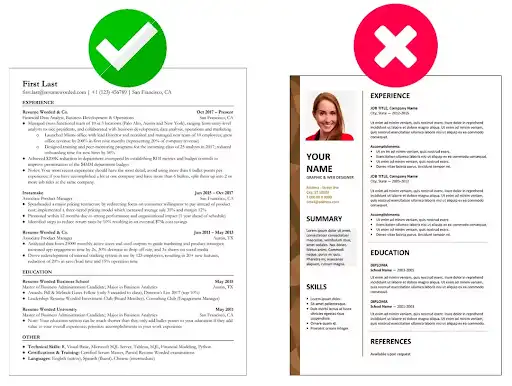
- Simple formatting (no tables, graphics, or unusual fonts that confuse ATS).
Step 6: Resume Personalization Beyond the Basics
Want to go beyond the standard? Try these resume targeting techniques:
- Mirror the company culture - If the company is innovative and casual, reflect that tone in your resume summary.
- Highlight measurable impact - Numbers stand out more than words. Always quantify results.
- Use industry-specific keywords - Tailor not just for the job but also for the sector (tech, finance, healthcare, etc.).
- Adapt layout for clarity - Recruiters prefer resumes that are easy to scan. Use bold for key achievements
Resume Personalization Guide: Common Mistakes to Avoid
❌ Sending the same resume everywhere.
❌ Using passive language like “responsible for” instead of active verbs like “developed” or “led.”
❌ Overloading with buzzwords but no proof.
❌ Forgetting to check spelling and grammar.
Personalized Resume Examples (2025 Edition)
Example 1: Software Engineer Resume Customization
- Tailored to emphasize coding languages, project management, and agile methodology.
- Adjusted for a fintech job by adding financial compliance knowledge.
Example 2: Marketing Resume Adjustment
- Customized to highlight data analytics, SEO, and AI-driven campaign tools.
- Modified to show alignment with KPIs mentioned in the job description.
Statistics That Prove Resume Customization Works
- 63% of recruiters say they reject resumes that are too generic.
- 75% of candidates fail ATS screening due to lack of keyword alignment.
- Job seekers with tailored resumes are 3x more likely to land interviews.
The Future of Resume Writing in 2025
With AI reshaping hiring, some experts predict resumes may one day be replaced by digital portfolios or skill badges. However, in 2025, resumes are still the core document recruiters rely on—especially when tailored and targeted correctly.
The Power of Resume Tailoring
Writing a resume in 2025 isn’t about cramming everything you’ve done into two pages. It’s about resume alignment with job requirements, showing that you’re the right person for the rоle.
By using resume customization tips, personalization strategies, and resume adjustment methods, you can ensure your application stands out to both recruiters and ATS.
Think of your resume as a living document—one that evolves with every job you apply for. When you craft a tailored resume, you’re not just applying for a job—you’re positioning yourself as the solution the employer is looking for.